
Who this is for: Property managers, HOA boards, and developers evaluating bulk apartment Wi-Fi for multi-dwelling units (MDUs) of 50+ units.
What you’ll get: A decision framework for choosing providers, negotiating contracts, and implementing building-wide internet without the common pitfalls that leave residents frustrated and boards locked into bad agreements.
Bulk apartment Wi-Fi has shifted from a luxury amenity to a baseline expectation. According to the National Multifamily Housing Council’s 2025 Renter Preferences Survey, 89% of renters rank reliable internet as their top amenity priority – ahead of fitness centers, pools, and package lockers.
The economics have changed too. Bulk internet contracts now cost 30–50% less per unit than individual resident subscriptions, while giving property owners leverage over service quality, support response times, and infrastructure upgrades. Property managers exploring bulk Wi-Fi services for apartments are finding significant cost advantages over traditional retail models. But the wrong contract can trap you for 7–10 years with outdated speeds and unresponsive vendors.
Fast path: If you’re already comparing providers, skip to the decision table in Section 2. If you’re unsure whether bulk Wi-Fi makes sense for your property, start with the cost model in Section 3.
What Is Bulk Apartment Wi-Fi and When Does It Make Sense?
Bulk apartment Wi-Fi is a building-wide internet service purchased by the property owner or HOA, then provided to all residents as part of their rent or HOA fees. Unlike retail internet where each resident contracts individually, bulk agreements give the property leverage to negotiate speeds, pricing, and service levels.
Three Delivery Models
Managed Wi-Fi: The provider installs and maintains all equipment, including in-unit access points. Residents connect to a building-wide network. Best for properties wanting hands-off management and consistent resident experience.
Bulk Wired + Resident Router: The provider delivers service to each unit via ethernet or coax. Residents use their own routers. Lower cost, but creates support complexity when residents blame the building for their router issues.
Hybrid Model: Building-wide Wi-Fi in common areas, with wired connections available in units for residents wanting dedicated bandwidth. Balances cost and flexibility.
When Bulk Wi-Fi Makes Financial Sense
Bulk apartment Wi-Fi typically delivers ROI when your property meets these thresholds:
- Unit count: 50+ units (some providers serve 20+ units, but pricing improves significantly at 50+)
- Current vacancy rate: Above 5% (internet amenity can reduce turnover)
- Building age: Properties built before 2010 often lack adequate wiring for gigabit speeds – bulk contracts can include infrastructure upgrades
- Competitive market: If nearby properties offer included internet, you’re losing prospects
When It Doesn’t Work
Bulk Wi-Fi creates problems in specific scenarios:
- High percentage of remote workers: Power users may need dedicated fiber lines that bulk shared bandwidth can’t guarantee
- Mixed-use buildings: Commercial tenants often have different bandwidth requirements and compliance needs—learn more about WiFi for commercial tenants to understand these distinctions
- Properties with existing long-term contracts: Breaking current agreements may cost more than waiting them out
For properties in suburban markets with lower population density, bulk Wi-Fi options may be limited to one or two providers. Urban properties typically have 3–5 viable options, giving more negotiating leverage.
The Market Shift
Federal infrastructure investments have expanded fiber availability to 78% of MDUs in metro areas, up from 61% in 2023. This means bulk apartment Wi-Fi contracts signed today should specify minimum speeds of 500 Mbps symmetrical, with upgrade paths to 1 Gbps within the contract term. Anything less locks you into yesterday’s standards.
How Do You Compare Bulk Apartment Wi-Fi Providers?
Provider selection determines 80% of your bulk Wi-Fi success. Use this decision table to evaluate options systematically.
Provider Comparison Criteria
| Criteria | Weight | What to Verify |
|---|---|---|
| Guaranteed speeds (not “up to”) | 25% | Request SLA with minimum throughput commitments |
| Support response time | 20% | Get written response time guarantees: 4-hour for outages, 24-hour for individual units |
| Contract flexibility | 20% | Exit clauses, technology upgrade provisions, rate caps |
| Installation timeline | 15% | Typical MDU installations take 60–120 days; get milestone commitments |
| Resident portal quality | 10% | Self-service password resets, usage monitoring, device management |
| References from similar properties | 10% | Contact 3+ properties of similar size and age |
Questions to Ask Every Provider
Before signing any bulk apartment Wi-Fi agreement, get written answers to these questions:
- What is the guaranteed minimum speed per unit during peak usage (7–10 PM)?
- Who owns the installed equipment at contract end?
- What happens if you’re acquired by another company?
- How are speed upgrades handled during the contract term?
- What’s the process and timeline for resolving resident complaints?
- Can residents purchase upgraded tiers directly from you?
Red Flags in Provider Proposals
Avoid providers who:
- Won’t provide reference contacts for properties they currently serve
- Quote “up to” speeds without guaranteed minimums
- Require contracts longer than 7 years without technology refresh clauses
- Can’t explain their support escalation process
- Bundle equipment costs into monthly fees without buyout options
For properties evaluating comprehensive bulk WiFi provider solutions, comparing at least three providers before negotiating ensures you understand market rates and standard terms.
What Does Bulk Apartment Wi-Fi Actually Cost?
Bulk Wi-Fi pricing varies significantly based on unit count, existing infrastructure, and contract length. Use these benchmarks to evaluate proposals.
Pricing Benchmarks
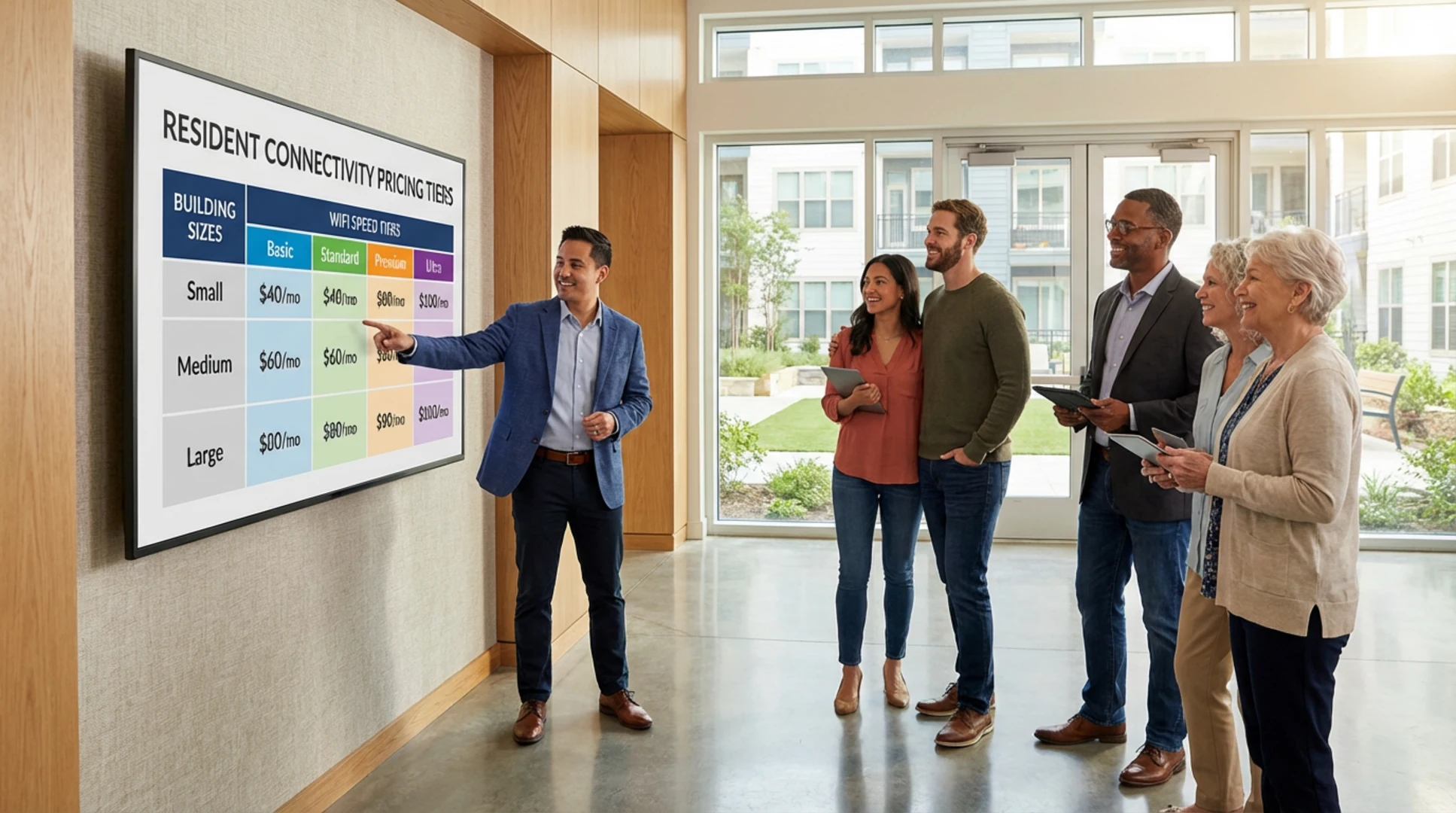
Per-unit monthly costs (managed Wi-Fi, 500 Mbps):
- 51–100 units: $45 – $50/unit
- 101–250 units: $50 – $55/unit
- 250+ units: $55 – $60/unit
Assumptions: These ranges assume existing Cat5e or better wiring, standard 5-year contract, and metro area location. Rural properties and buildings requiring complete rewiring will see 20–40% higher costs.
Hidden Costs to Budget For
Proposals often exclude costs that appear later:
- Infrastructure upgrades: $150–400 per unit for buildings needing new cabling
- Common area coverage: $2,000–8,000 per access point for lobbies, pools, fitness centers
- Resident support overflow: Some contracts charge per-ticket fees after a monthly threshold
- Equipment refresh: Access points need replacement every 4–5 years; clarify who pays
- Speed tier upgrades: Moving from 500 Mbps to 1 Gbps mid-contract may trigger price increases
Cost Model: 100-Unit Property Example
Scenario: 100-unit apartment complex, built 2008, existing coax wiring, requesting 500 Mbps managed Wi-Fi.
Upfront costs:
- Infrastructure assessment: $1,500
- Wiring upgrades (30 units): $12,000
- Access point installation: $8,000
- Project management: $2,500
- Total upfront: $24,000
Monthly costs:
- Per-unit service (100 × $32): $3,200
- Common area coverage: $400
- Support tier upgrade: $200
- Total monthly: $3,800
5-year total cost of ownership: $252,000
Compare this to individual retail subscriptions: At $65/month average, 100 units paying individually would spend $390,000 over five years. The bulk model saves approximately $138,000 while providing consistent service quality and centralized support.
How to Pass Costs to Residents
Properties typically recover bulk Wi-Fi costs through one of three models:
- Rent inclusion: Increase rent by the per-unit cost. Simplest approach, but may affect rent-controlled properties.
- Amenity fee: Add a separate line item on the lease. Provides transparency but creates collection complexity.
- HOA assessment: For condos, add to monthly HOA fees. Requires board approval and proper disclosure.
How Do You Implement Bulk Apartment Wi-Fi Successfully?
Implementation failures cause more resident complaints than provider quality. Follow this phased approach to minimize disruption.
Phase 1: Pre-Contract (Weeks 1–4)
Checklist:
- Survey residents about current internet satisfaction and usage patterns
- Audit existing infrastructure (wiring type, condition, pathway availability)
- Review current provider contracts for termination requirements
- Identify decision-makers and approval process (board vote, owner approval)
- Request proposals from minimum 3 providers
Phase 2: Contract Negotiation (Weeks 5–8)
Non-negotiable contract terms:
- Guaranteed minimum speeds (not “up to”)
- Support response time SLAs with penalty clauses
- Technology refresh provision at year 3 or 4
- Exit clause for chronic underperformance (define metrics)
- Rate cap for annual increases (target: CPI + 2% maximum)
- Equipment ownership at contract end
For guidance on contract terms specific to MDU WiFi services, consult with a telecom attorney before signing agreements over $100,000 total value.
Phase 3: Installation (Weeks 9–16)
Resident communication template:
“Starting [date], we’re upgrading to building-wide high-speed internet. Here’s what to expect:
- Week of [date]: Technicians will access utility areas (no unit entry needed)
- Week of [date]: In-unit installation (30-minute appointments, you’ll receive scheduling link)
- Go-live date: [date]
- Your current provider: Cancel after [go-live date] to avoid overlap charges
- Questions? Contact [property manager email/phone]”
Installation oversight checklist:
- Require daily progress reports from installer
- Test 10% of units randomly before accepting completion
- Document all wiring changes with photos
- Verify common area coverage meets specifications
- Confirm resident portal is functional before go-live
Phase 4: Go-Live and Stabilization (Weeks 17–20)
First-week priorities:
- Staff the front desk or management office with provider support contact information
- Monitor social media and resident forums for complaints
- Track ticket volume daily—spikes indicate systemic issues
- Conduct speed tests in 5 units at peak hours (8 PM)
- Document any SLA violations immediately
30-day review meeting agenda:
- Ticket volume and resolution times vs. SLA
- Speed test results vs. guaranteed minimums
- Resident satisfaction feedback
- Outstanding installation punch list items
- Billing accuracy verification
Your Next Steps
Bulk apartment Wi-Fi decisions affect resident satisfaction, property value, and operational complexity for 5–10 years. Approach them with the same rigor you’d apply to any major capital improvement.
This week: Survey 10 residents about their current internet experience. Ask about speed satisfaction, outage frequency, and what they pay. This baseline data strengthens your negotiating position.
This month: Request infrastructure assessments from two providers. These are typically free and reveal what upgrades your building needs before you can evaluate pricing accurately.
Before signing: Contact three references from each finalist provider. Ask specifically about support responsiveness, speed consistency during peak hours, and how the provider handled problems.
The bulk apartment Wi-Fi market favors prepared buyers. Providers expect property managers to accept standard terms—those who negotiate with data and clear requirements consistently secure better pricing, stronger SLAs, and more flexible contracts.
For properties just beginning to explore shared WiFi for apartments, start with the infrastructure audit. Everything else—provider selection, contract terms, implementation planning—depends on understanding what your building can support today and what upgrades it needs.