


There’s a version of this conversation that happens in leasing offices across the country. A resident submits a maintenance request, not about a leaky faucet or a broken elevator, but about the internet. The Wi-Fi drops during video calls. The signal doesn’t reach the bedroom. The speeds are fine in the morning but crawl by 9 pm. The property manager looks into it, finds nothing obviously wrong, and closes the ticket. The resident leaves a two-star review on Google and doesn’t renew.
That pattern is becoming more common, and it has almost nothing to do with how much bandwidth the building is paying for. It has to do with the wireless infrastructure inside the walls.
Internet Is Now a Load-Bearing Amenity
Ten years ago, a resident who wanted fast internet called their cable company and sorted it out themselves. The property owner had nothing to do with it. That model is dead in competitive multifamily markets.
According to Parks Associates, 71% of renters say immediate Wi-Fi availability is a deciding factor when choosing where to live. More than 40% expect the internet to be working on move-in day, before they’ve unpacked a single box. In markets where a resident has three or four comparable buildings to choose from, the one with unreliable Wi-Fi loses leases it should have won.
This shift has turned network infrastructure into something closer to plumbing than a premium amenity. Residents don’t think about it when it works. They think about nothing else when it doesn’t.
The average U.S. household now connects more than 20 devices to its home network, according to Deloitte’s 2023 Connectivity and Mobile Trends survey. Phones, laptops, smart TVs, thermostats, doorbells, speakers, tablets, gaming consoles. Multiply that across a 150-unit building and you have thousands of devices competing for wireless airtime at any given moment. The question is whether your infrastructure was built to handle that, or whether it was built for a world that no longer exists.
What Wi-Fi 6 Was Designed For (and Where It Falls Short)
Wi-Fi 6 came out in 2019. At the time, it was a genuine improvement over what came before. It handled multiple devices more efficiently, reduced some of the congestion problems that older standards created, and performed better in moderately dense environments.
The problem is that 2019 is now six years ago, and the environment Wi-Fi 6 was designed for doesn’t match what operators are managing today.
Wi-Fi 6 works on a simple principle: one device connects to one band at a time. The access point serves devices in sequence, managing the queue as best it can. In a single-family home or a small office, that’s fine. In a building with hundreds of units, each running dozens of devices, that queue gets very long very fast.
Think of it like a two-lane road built when the town had 5,000 people. It worked. Then the town grew to 50,000, and now there’s a traffic jam every evening. The road didn’t get worse. The demand outgrew the design.
Wi-Fi 6 also struggles with a specific problem in multifamily buildings: interference. Every unit that has its own router, or every access point that wasn’t planned as part of a coordinated network, broadcasts its own signal into the same shared airspace. In a 200-unit building, that can mean hundreds of competing signals stepping on each other. The result isn’t a gradual slowdown. At a certain point of congestion, performance falls off a cliff.
A Wi-Fi 6 deployment can be well-managed and still hit that wall, because the standard itself doesn’t have the tools to handle what modern residential density demands.
What Wi-Fi 7 Actually Does Differently
Wi-Fi 7 (IEEE 802.11be) was finalized by the Institute of Electrical and Electronics Engineers and certified by the Wi-Fi Alliance in 2024. The improvements aren’t cosmetic. Three changes matter for multifamily operators.
Devices can use multiple bands at the same time.
Under Wi-Fi 6, a device picked one frequency band and used it. Under Wi-Fi 7, a device can use two or three bands simultaneously and combine them into a single, faster, more stable connection. The network allocates whichever combination is performing best at that moment, automatically, without the resident doing anything.
In practical terms, a resident’s laptop in a back bedroom isn’t stuck on a weak signal just because the strongest frequency doesn’t reach that far. The device uses whatever combination of bands gets it the best connection, and the switch is invisible. No dropped calls, no buffering, no manually switching networks.
The network can carry far more traffic without slowing down.
Wi-Fi 7 roughly doubles the channel width available to a single access point compared to Wi-Fi 6, and improves how efficiently data is packed into that channel. For a building where dozens of residents are streaming, video-calling, and gaming at the same time, this means the network has significantly more headroom before it starts degrading. The ceiling is high enough that demand growth over the next several years is unlikely to approach it.
Interference from neighboring networks stops being a fixed penalty.
In dense urban and suburban buildings, interference from other networks is unavoidable. Other properties, commercial spaces, parking structures all generate wireless signals that occupy parts of the available spectrum. Wi-Fi 6 absorbed that interference as a performance penalty. Wi-Fi 7 can identify which portions of the spectrum are polluted and route traffic around them, using the clean portions more efficiently. For operators in dense markets, this is a meaningful difference in day-to-day reliability.
The Business Case for Committing to Wi-Fi 7 Now
The spec improvements matter, but they’re not the reason to commit to Wi-Fi 7 today. The reason is the upgrade cycle.
Network infrastructure in a multifamily building is not something you swap out every two years. A well-structured managed network agreement runs eight to ten years. The equipment you install today will be the equipment your residents use in 2032 and 2033. At the pace that connected devices are proliferating, a Wi-Fi 6 network installed now will be operating near its capacity limits well before that contract expires.
That means a forklift upgrade somewhere in year four or five, along with the cost, disruption, and resident friction that comes with it. Or it means a network that’s functional but can’t keep pace with resident expectations, which shows up in reviews, in churn, and in concessions offered to retain tenants who have a better option down the street.
Wi-Fi 7 is already the standard that new client devices are being built around. Qualcomm, Intel, and Apple have all moved their consumer device lines toward Wi-Fi 7 radios. A resident moving into your building in 2026 with a new laptop or phone will have hardware capable of Wi-Fi 7. A Wi-Fi 6 network leaves that capability unused.
Deploying Wi-Fi 7 now buys a longer runway before the next infrastructure decision. The operator who installs it in 2025 makes one network decision for the next decade. The operator who installs Wi-Fi 6 in 2025 likely makes two.
What a Well-Designed Wi-Fi 7 Deployment Looks Like
The standard itself is only part of the equation. A Wi-Fi 7 network installed without proper planning won’t outperform a well-designed Wi-Fi 6 network. The access point placement, the backhaul infrastructure, the per-unit segmentation, and the ongoing network management all determine whether residents feel the difference.
A few things that separate a well-executed deployment from one that just has newer hardware on the wall:
- Common areas go live first. Lobbies, amenity spaces, leasing offices, and corridors get coverage on day one, without requiring access to occupied units.
- Each unit’s network traffic is isolated from the others. A resident in unit 4B cannot see traffic from unit 4C, which is a basic security requirement for any property running shared infrastructure.
- The network is monitored continuously. Issues are identified and addressed before residents notice them, rather than after a complaint arrives.
- No technician visits are needed for resident activations or tier changes. Everything is handled remotely.
We at Quantum Wi-Fi have deployed Wi-Fi 7 infrastructure across properties in New York, Philadelphia, Detroit, Cleveland, and South Florida, including across the Lynd Living portfolio spanning roughly 34 cities. Across those deployments, residents in buildings with a properly designed Wi-Fi 7 network generate a fraction of the connectivity complaints that residents in older or unmanaged networks do. That difference shows up in reviews, in renewal conversations, and in the workload of on-site staff.
The Decision
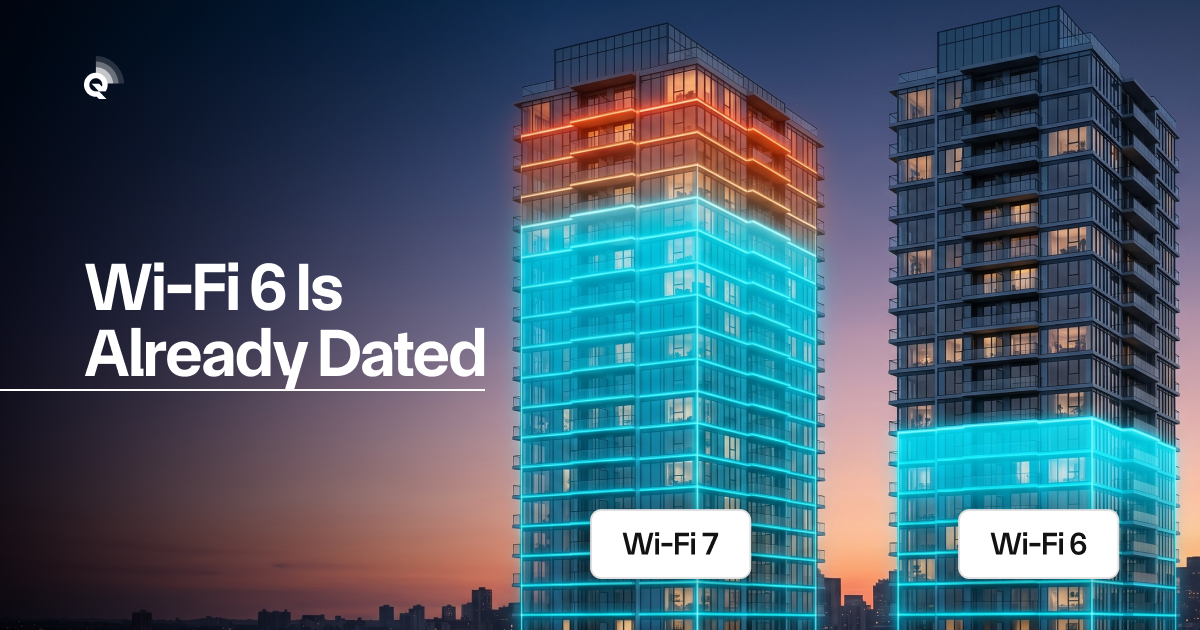
Wi-Fi 6 isn’t broken. In the right context, with the right management, it still performs adequately. But “adequately” is a hard position to defend when a newer building down the street is offering something noticeably better, and when the residents signing leases today are carrying devices that Wi-Fi 6 was never designed to serve at full capacity.
The operators who will be best positioned three, five, and eight years from now are the ones who treat network infrastructure the way they treat HVAC or elevator systems: as a long-term capital decision with real consequences for asset value and resident retention, not as a utility someone else manages.
Wi-Fi 7 is what that long-term decision looks like in 2025. The case for waiting hasn’t gotten stronger.