
In apartment buildings, condominiums, and other multifamily communities, internet connectivity has become core infrastructure. Residents now expect to be online the moment they move in, with networks capable of supporting remote work, streaming media, smart-home systems, and telehealth without disruption. For developers, HOAs, and property operators, the choice of internet infrastructure is no longer a short-term amenity decision. It is a long-term investment that directly affects resident satisfaction, operational efficiency, and asset value.
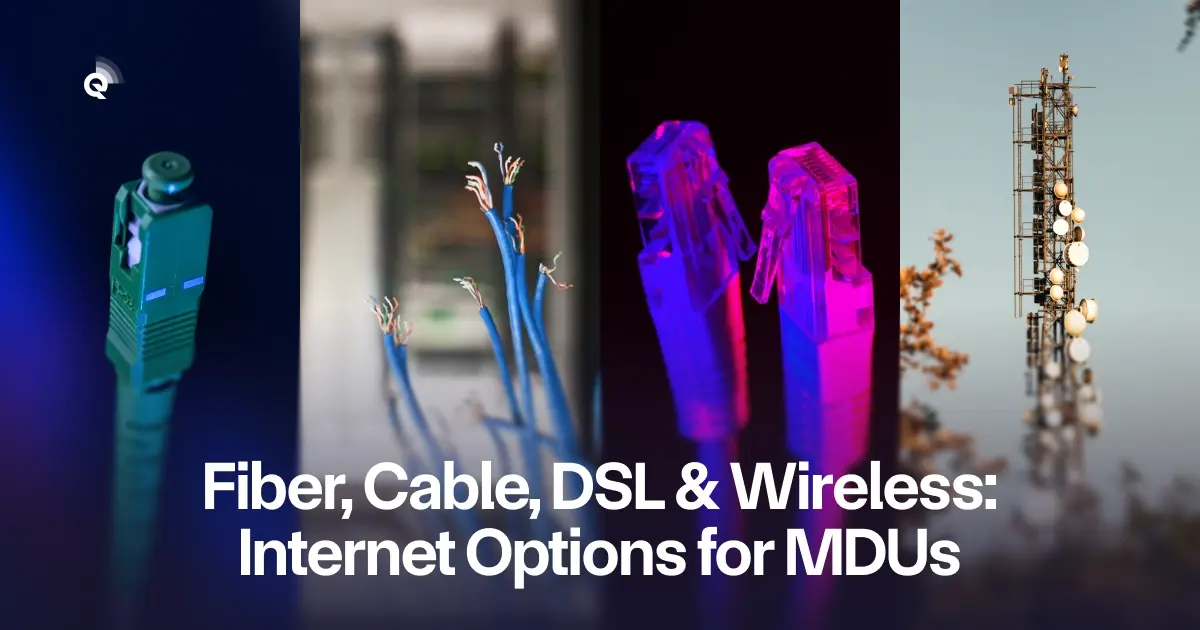
Modern cities rely on four primary types of fixed internet connections: fiber, cable, DSL, and fixed wireless access (FWA). While all four remain in use today, they differ significantly in performance, reliability, and suitability for dense residential environments. Understanding these differences is essential when planning connectivity for apartment buildings and multifamily developments.
This article examines each connection type and explains why fiber has emerged as the most durable foundation for modern multifamily communities.
Fiber Internet for Apartments and Multifamily Buildings
Fiber internet delivers data as pulses of light through strands of glass or plastic. Unlike copper-based systems, fiber can transmit enormous amounts of information with minimal signal loss and extremely low latency. In apartment buildings, fiber is commonly deployed as fiber to the building (FTTB) or fiber to the unit (FTTU), often feeding enterprise-grade Ethernet or managed Wi-Fi networks throughout the property.
Performance data illustrates why fiber is widely considered the gold standard. Federal broadband measurement programs show that fiber connections consistently deliver the fastest median download and upload speeds among all fixed technologies, with symmetrical performance and latency typically around 20 milliseconds or lower. This responsiveness enables high-quality video conferencing, cloud applications, real-time gaming, and increasingly complex smart-home ecosystems.
Beyond raw performance, fiber offers structural advantages that are especially important in MDUs. Fiber cables are immune to electromagnetic interference, less affected by weather, and degrade far more slowly than copper. Fiber networks installed decades ago remain serviceable today, with upgrades achieved by replacing electronics rather than the physical cable itself. Although installation costs are higher than legacy options, fiber’s longevity and low maintenance requirements often make it the most cost-effective solution over a building’s lifespan.
For new developments and major renovations, fiber provides a future-proof foundation capable of scaling as resident demand grows.
Cable Internet in Apartment Buildings
Cable internet evolved from coaxial television networks and is typically delivered via hybrid fiber-coaxial (HFC) architecture. Fiber runs from a headend to neighborhood nodes, and coaxial cable distributes service from those nodes to individual buildings and units.
Cable remains the most widely deployed fixed broadband technology in U.S. cities. Government estimates indicate that a majority of residential fixed connections still rely on cable infrastructure. Modern DOCSIS standards allow cable networks to deliver high downstream speeds, often ranging from hundreds of megabits per second to gigabit-class service.
However, cable networks are inherently shared. Multiple households connect to the same coaxial segment, which means available bandwidth is divided among users. During peak usage periods, residents may experience slower speeds or inconsistent performance. Upload capacity is also significantly lower than download capacity, which can constrain remote work, cloud backups, and interactive applications.
Cable internet continues to serve many apartment buildings effectively, particularly where fiber is not yet available. Over time, however, the limitations of shared bandwidth and asymmetrical performance become more pronounced as resident usage patterns shift toward uploads and real-time applications.
DSL Internet: A Declining Legacy Technology
Digital Subscriber Line (DSL) uses existing copper telephone lines to transmit data. By leveraging twisted pairs of copper wires, DSL once provided an affordable path to broadband without major infrastructure upgrades.
Today, DSL is the weakest of the four mainstream internet options. Speeds are highly distance-sensitive, latency is relatively high, and upload capacity is limited. In many markets, DSL delivers only a fraction of the performance offered by cable or fiber.
DSL’s market share has steadily declined and now represents a small portion of fixed residential connections. Some older apartment buildings continue to rely on DSL where alternative infrastructure is unavailable, but the technology struggles to meet modern expectations for video conferencing, streaming, and connected devices. Maintaining aging copper networks is also increasingly costly for operators.
In practical terms, DSL functions primarily as a transitional solution until higher-capacity infrastructure is deployed.
Fixed Wireless Internet for Multifamily Properties
Fixed wireless access delivers internet service via radio signals rather than physical cables. Antennas installed on buildings communicate with nearby cellular towers, enabling rapid deployment without trenching or extensive construction. Recent advances in 4G and 5G networks have significantly improved fixed wireless performance, driving growing adoption.
Fixed wireless offers clear advantages in speed of installation and flexibility. It can be effective in areas where wired infrastructure is impractical or as a temporary or backup connection. Advertised download speeds can be competitive with cable in some conditions.
However, fixed wireless faces structural challenges in dense apartment environments. Radio spectrum is shared among users, signal quality depends on line-of-sight and building materials, and higher-frequency signals struggle to penetrate walls. Performance can fluctuate due to congestion, weather, or foliage, and latency remains higher than fiber.
As a result, fixed wireless is best suited for low-density properties, interim deployments, or redundancy rather than as the primary network for large multifamily buildings.

Comparing Internet Options for MDUs
When evaluating internet options for apartment buildings, several factors consistently matter: performance, reliability, scalability, and long-term viability.
Fiber delivers symmetrical multi-gigabit speeds, minimal latency, and the highest reliability. Cable provides strong downstream performance but limited uploads and shared capacity. DSL falls well below modern requirements. Fixed wireless occupies a middle ground, offering convenience and flexibility with variable performance.
Scalability further differentiates these technologies. Fiber’s capacity can increase dramatically by upgrading electronics, with theoretical limits far beyond current residential demand. Cable continues to evolve through DOCSIS standards but remains constrained by shared coax segments. DSL has reached its practical ceiling, and fixed wireless is limited by spectrum availability and physical propagation constraints.
Why Fiber Is the Long-Term Foundation for Modern Communities
For multifamily developers, HOAs, and asset managers, the long-term evidence strongly favors fiber. Resident expectations continue to rise as applications become more bandwidth-intensive and latency-sensitive. Streaming ultra-high-definition video, uploading large files, supporting smart-building systems, and enabling telehealth all demand consistent, high-capacity connections.
Deploying fiber during construction or major renovations avoids costly retrofits and positions properties as future-ready. Multiple studies associate fiber connectivity with higher property values, improved resident retention, and stronger net operating income. When paired with professionally managed networks, fiber backbones also simplify operations, reduce support issues, and enable advanced building services.
While cable, DSL, and fixed wireless will persist in various roles, fiber stands apart as the most resilient and adaptable infrastructure for dense urban environments.
Conclusion
Modern cities rely on a mix of internet technologies, but not all are equally suited to apartments and multifamily communities. Cable and DSL continue to serve legacy roles, and fixed wireless expands access where wiring is impractical. Yet for properties seeking long-term reliability, scalability, and resident satisfaction, fiber remains the strongest foundation.
Quantum Wi-Fi designs and operates managed networks built on this infrastructure, supporting modern communities with connectivity engineered for density, performance, and longevity.