
The Collision of Expectations and Infrastructure
A decade ago, moving into a new apartment meant waiting for an installer to show up sometime between 1 p.m. and 5 p.m. and hoping the modem would cooperate. Today, nearly every U.S. adult uses the internet, and broadband adoption is approaching universal levels.
Research on renters shows that 41% expect to have internet service to be ready on move‑in day, while more than a third specifically look for gigabit speeds and roaming capability throughout the property. Meanwhile, the average household now contains more than twenty connected devices. These include smart TVs, phones, thermostats, security cameras, and work‑from‑home setups. Despite this explosion of demand, most apartment buildings still operate like it’s 2010. Every unit installs its own consumer router on a crowded, unregulated radio spectrum and hopes for the best.
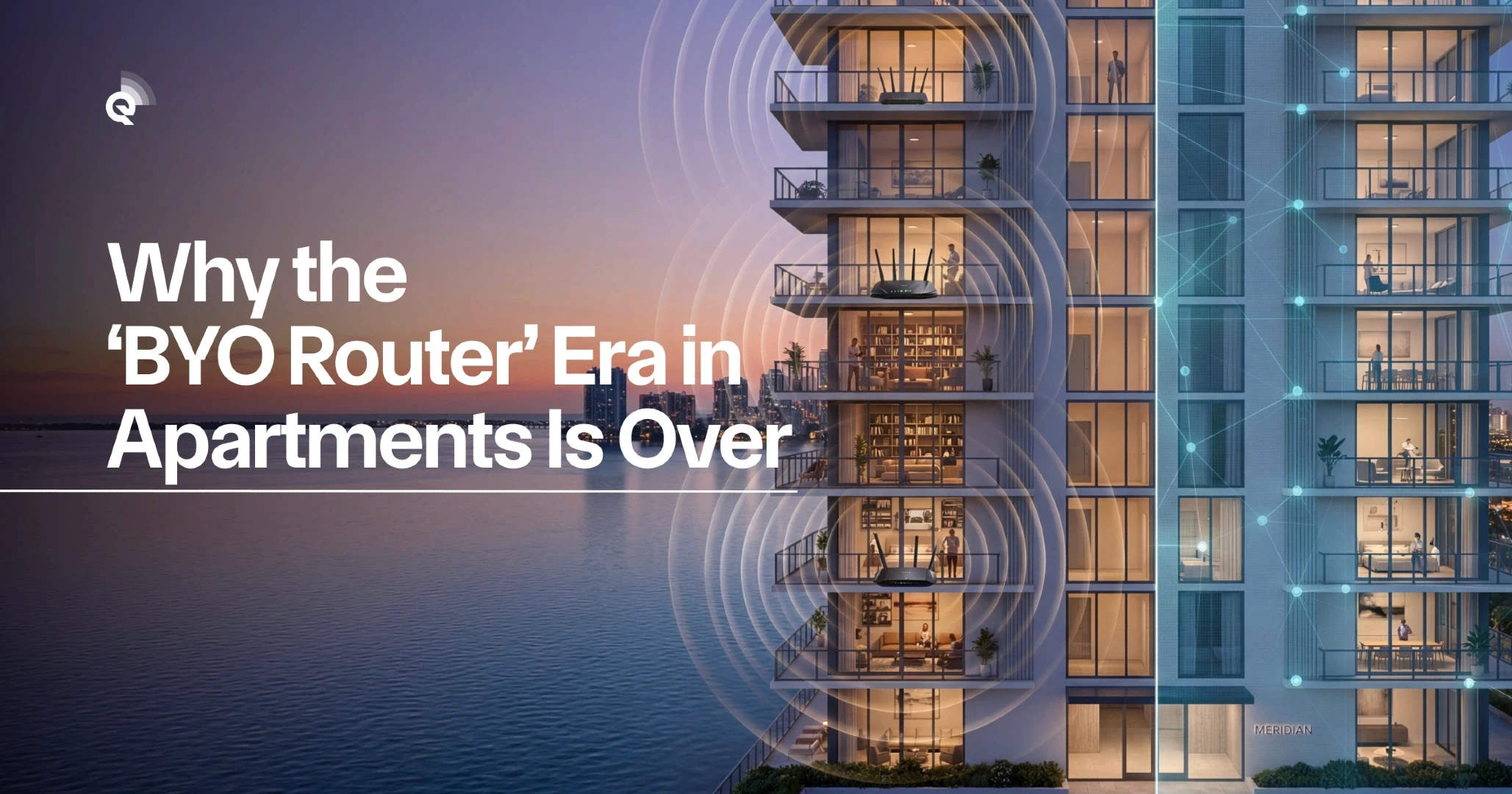
The Wi‑Fi Wars: Dozens of Routers in One Building
When every resident brings their own router, a 200‑unit building can easily end up with hundreds of access points blasting signals into the same airspace. Wi‑Fi in the 2.4 GHz band has only three non‑overlapping channels, and the 5 GHz band supports about two dozen. Each apartment competes for the same limited spectrum while devices cycle between streaming video, gaming, and video conferencing.
The result is a constant battle for airtime. It’s like stuffing everyone in a crowded room and handing each person a megaphone where nobody can understand anyone else because the voices constantly overlap.
Hidden Technical Breakdowns: Co‑Channel Interference
Wi‑Fi networks follow polite rules. Before a device transmits, it listens to see if the channel is free. When multiple routers use the same channel, Co‑Channel Interference (CCI) forces clients to wait longer to transmit. Technical research notes that user experience begins to degrade once channel utilization climbs above 50 percent. Voice and video quality deteriorate rapidly, and complete connection drops occur as utilization approaches 80 percent.
Because there are so few clean channels, residents in dense buildings inevitably end up sharing channels. This turns every neighbor’s router into a source of congestion.
Airtime Contention and the Myth of More Routers
Adding more access points doesn’t fix congestion; it makes it worse. Unlike cellular networks, Wi‑Fi relies on a shared medium. More routers mean more broadcast beacons, more management frames, and more devices competing for time to speak. In practical terms, this translates into slower speeds, buffering video, dropped calls, and frustrated residents. No amount of marketing spin can change the physics of the radio spectrum.
The Operational Fallout
Technical friction quickly becomes a business problem. Residents experiencing slow internet complain, leave negative reviews, or churn at lease renewal. Property managers juggle dozens of support calls each month (often about issues outside their control) while on‑site staff struggle to triage router resets and dead spots.
In a market where high‑speed connectivity is now a core amenity, buildings offering poor Wi‑Fi risk being filtered out during apartment searches. The choice between unmanaged chaos and a controlled network directly affects Net Operating Income (NOI) and brand reputation.
Why This Problem Gets Worse Every Year
|
Trend Factor |
The Reality for MDUs |
|
Device Growth |
U.S. households now average around 22 connected devices, drastically increasing airtime consumption and network strain. |
|
Bandwidth Demand |
High-definition streaming, cloud gaming, and remote work require consistent, low-latency connections that legacy routers can’t sustain. |
|
Tenant Expectations |
41% of renters expect plug-and-play internet on move-in day, and a third demand seamless roaming across all amenity spaces. |
|
Real Estate Economics |
Properties with fiber-connected, high-speed internet command higher rents that are reported to be over 10% higher than those without. |
A BYO‑router environment cannot keep up with these trends. Each consumer router is completely blind to its neighbors.
The Infrastructure Shift: Why Managed Wi-Fi for Apartments is the New Standard
The alternative to BYO chaos is a controller‑managed network that spans the entire property. This is where our purpose-built solution changes the equation.
Instead of residents relying on isolated, off-the-shelf devices, we build our networks on professional-grade Wi-Fi 7 equipment and a 100% fiber-optic network. This centralized system places enterprise‑grade access points throughout the building. These access points are connected back to a smart controller that automatically assigns channels, balances client loads, and reduces Co-Channel Interference by selecting non‑overlapping frequencies.
Translating the Tech: Why Wi-Fi 7 Matters For a building to truly support modern smart home tech and heavy streaming, it needs the right technical foundation. Quantum WiFi utilizes the latest Wi-Fi 7 standard, which supports the 2.4, 5, and 6 GHz bands and allows for a massive 10 Gbps maximum throughput.
Speed isn’t the only factor; efficiency is key. Advanced standards introduce features like OFDMA and MU-MIMO. In simple terms:
-
Think of legacy Wi-Fi like a delivery truck that can only carry one package to one house at a time, causing major traffic jams.
-
Think of Wi-Fi 7 like a fleet of delivery trucks that can group packages together and deliver them to multiple houses simultaneously.
Additionally, Wi-Fi 7 opens up wider 320 MHz channels. This is the equivalent of taking a congested two-lane road and expanding it into a massive, eight-lane superhighway. These features require central coordination and cannot be orchestrated by hundreds of independent consumer routers.
Property‑Wide Roaming and Instant Activation
With a legacy system, residents are tethered to the routers in their personal units. A managed network eliminates these boundaries. A single, unified network connects every part of the property and outdoor spaces. Subscribers experience instantaneous hotspot hand-offs, meaning they can walk from their apartment to the pool or gym without dropping a video call or manually switching to a guest network.
Furthermore, managed systems provide immediate, day-one internet availability without the need for service calls or installation appointments. For property managers, this means zero truck rolls, zero scheduling friction, and no on-site technician dependency.
The Business Impact: A “One-and-Done” Fiber Investment
A centrally managed network is core infrastructure that directly influences asset performance. Traditional providers often lock communities into rigid pricing that fails to adjust as resident needs change.
By contrast, modern managed Wi-Fi empowers asset managers to unlock new revenue streams competitors can’t deliver. By leveraging flexible revenue share models, properties can generate predictable, recurring income directly from internet services. This transforms connectivity into a profit center instead of a sunk cost. Furthermore, by partnering with us (we offer $0 per-door installation fees compared to legacy ISPs charging $200 to $500 per door ), properties see immediate, measurable gains in asset value.
Crucially, installing a fiber network is a future-proof investment. Because our modular design makes it simple to scale and add bandwidth without delays, developers and HOAs don’t have to worry about ripping open drywall in five years to run new cables. The network expands alongside the property effortlessly.
Conclusion: The Inevitable Evolution
The bring‑your‑own‑router model emerged when broadband penetration was low, device counts were manageable, and tenants were willing to wait days for a technician. Those conditions are long gone. Today’s renters expect instant‑on, gigabit‑fast, everywhere‑reachable Wi‑Fi. They bring dozens of devices that completely overwhelm unmanaged apartment networks.
Centralized, managed Wi‑Fi addresses these structural limitations. For property owners, this shift isn’t just about technology. It is about protecting asset value, boosting NOI, and meeting the expectations of a new generation of residents.
Are you ready to turn your property’s connectivity into a competitive edge? Learn how we deliver stronger signals, faster service, and better margins for property owners by submitting this form or contacting sales@quantumwi.fi.